
Newberg Address Trail by Era
There is no single official list of every earlier household at a Newberg address. A sound backward trail separates ownership, occupancy, construction, and family events. Start with current parcel data to establish the address and tax lot. Then add the recorded transfer, printed directory or phone-book date, map edition, census, permit, and archive index that fits the period. Agreement among these sources is more useful than a match in only one of them.
| Historical source | Years documented | Holder or route | Address-history value |
|---|---|---|---|
| County real-property records | Early 1850s onward in office | Yamhill County Clerk Records Division | Title-affecting documents and recorded parties |
| Assessor and GIS account data | Current public data; reviewed account example had 2012-2025 valuation history | Ascend, GIS Hub, Assessor | Situs, assessed owner, mailing record, and deed clues |
| City directories and phone books | 1909-2015 selected runs and gaps | Yamhill County History Museum | Printed name and address snapshots |
| Sanborn maps | 1892, 1902, 1905, 1912, 1929 | Newberg Public Library | Street, building, and use context |
| Federal census | 1790-1950 public releases | National Archives and library access | Household and enumeration-date context |
| OHRI estate and guardianship records | Estates 1843-1942; guardianships 1850-1951 | Oregon State Archives | Index leads to estate or family records |
The Yamhill County Clerk says its ownership records can trace property back to the early 1850s. That describes office history, not a public web-search coverage date. The county's Digital Research Room led to a disclaimer and login gateway during the research review, so the safe sequence is the portal or permitted remote account, then the Clerk's research lobby or request channel when a web gap remains.
The Yamhill Digital Research Room gateway is shown below.
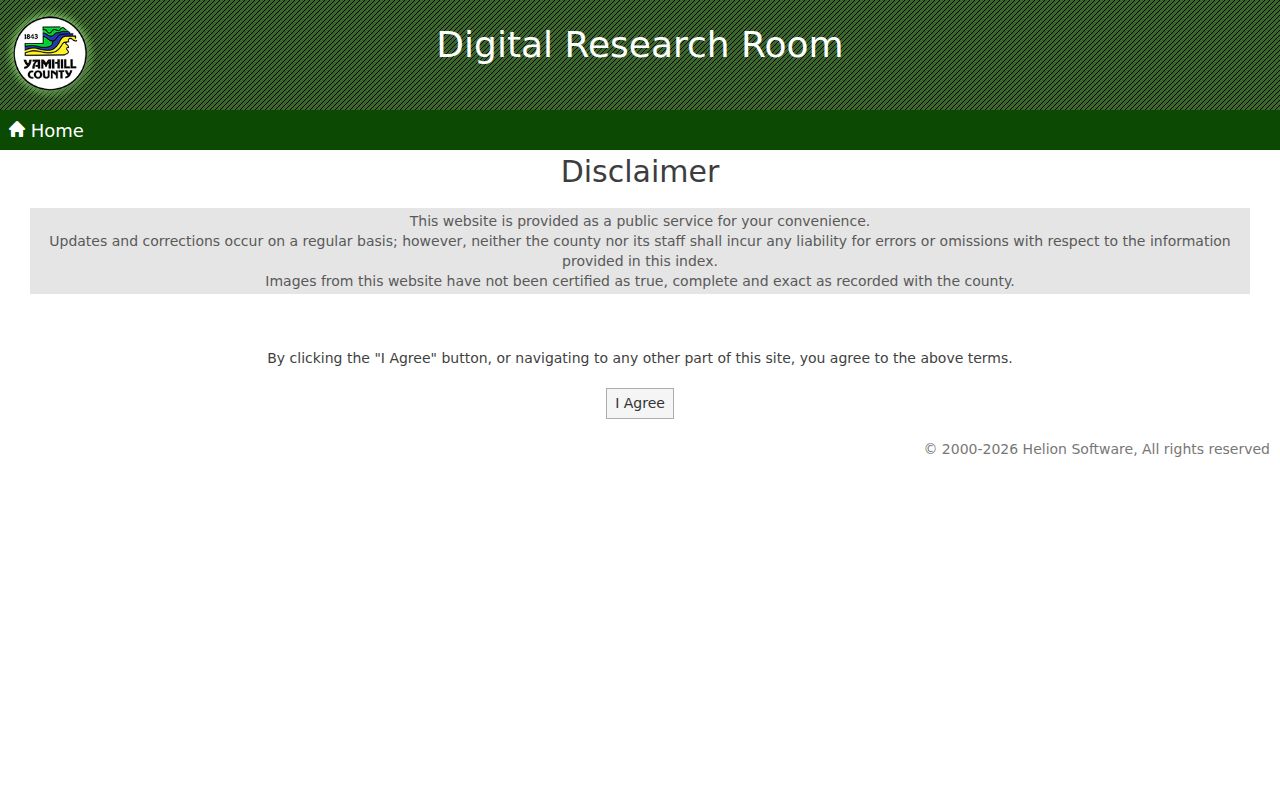
The gateway's disclaimer and account route are important context, because detailed public search fields and the earliest online year were not exposed in the reviewed session.
Newberg Property Records Start at Taxlots
The official first step for a Newberg address is the Yamhill Ascend Property Search, not a name search. Its public form offers account number, alternate account number, or a required street address, with optional city, state, and ZIP. The County provides examples such as Main, 123 Main St, and 123% Main; the percent sign works as a wildcard between the number and street name. Most fields need at least three characters, while account number needs two.
Save the account and map tax lot before leaving the result. The County tax-lot layer separately labels situs address, assessed owner, and tax-statement mailing fields. It can also provide deed year, deed number, deed type, sale date, sale price, assessor-map, and property-summary links. Those details are useful transfer clues, but the assessed owner or mailing destination is not proof of who occupied the house. A tax lot is the parcel identity that carries an address forward into legal-description work.
- Situs address
- The physical property location used by the assessment record. It is distinct from the tax-statement mailing address.
- Tax lot or account
- The assessment parcel identifier that links a street address to map and property-summary material.
- Legal description
- The land description used in recorded documents, such as lot and block, metes and bounds, partition plat, or a prior recording reference.
Note: Keep the address, tax lot, and legal description as separate research keys because Yamhill land records do not treat a street address as the legal description.
Newberg Previous Residents Through Deeds
A deed chain follows ownership interests, so it is the best backbone for past-owner research but not a complete list of past residents. The Yamhill County Clerk records deeds, mortgages, liens, plats, subdivision maps, recordable death certificates, and other title-affecting instruments. It says that an index and scanned image are made when a document is recorded. Start with the account's deed clue and legal-description context, then seek the actual transfer document through the Digital Research Room or at the Clerk counter.
- Find the current address in Ascend and save the tax lot, account, deed clue, and available map or property-summary link.
- Convert the property into its subdivision lot and block, metes-and-bounds, partition-plat, or prior-recording description.
- Ask for or locate the current transfer by the legal description, recording clue, and party name, then record date, document type, and recording number.
- Treat the seller or transferor, together with the same legal description, as the key for the earlier conveyance.
- Repeat backward, checking for refinances, reconveyances, liens, plats, and tax-lot changes that are not ownership transfers.
- Grantor
- The party conveying an interest in the recorded instrument.
- Grantee
- The party receiving that interest in the recorded instrument.
- Chain of title
- The sequence of property-interest documents linked by parties and the same legal description.
Record book/page or recording number, exact party spelling, date, and changes in the legal description at every step. A deed can include a return or tax-statement address, but those addresses are still correspondence clues, not a reliable statement of residency.
Newberg Public Access Gaps
The online route has real limits. The Clerk's public page does not publish the Digital Research Room's earliest online index year, and the research session reached a login screen rather than a detailed field list. For an earlier volume or a search that needs an actual instrument, use the Clerk Records Division's public research lobby. Document viewing there is free. The office also accepts requests by phone at 503-434-7518 or email at clerk@yamhillcounty.gov.
Yamhill County's recording-office page provides the counter and document-access route shown below.
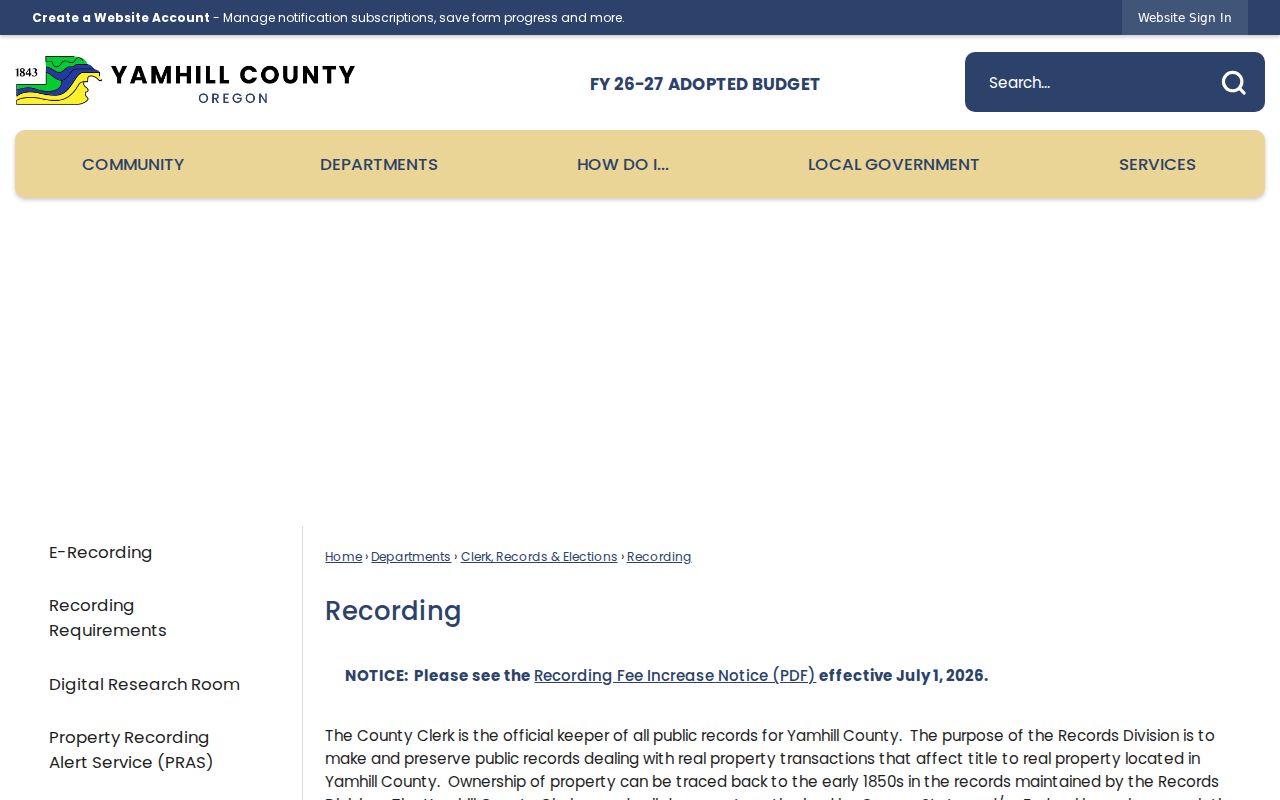
The Clerk lists self-made lobby prints at $0.25 per page, staff-made copies at $4 for the first page plus $0.25 for each additional page, and certification at an added $3.75. Remote access for bulk users is listed at $125 monthly plus a $130 setup fee, effective 2024. Ask for a grantor/grantee, legal-description, book/page, recording-number, or archived-volume search rather than assuming a web result is complete.
The County's written public-records route is another fallback for a nonexempt county document not located through an office index. Requests must be written, and the County may recover actual research, review, redaction, copying, certification, mailing, media, or attorney-review costs. It states a five-business-day acknowledgement or completion framework, followed by a completion or still-processing notice within ten business days after the acknowledgement deadline, subject to statutory exceptions.
Newberg Past Residents in Directories
Deeds show an ownership event. Directories and phone books add a dated printed household or business listing, with important gaps. The Yamhill County History Museum identifies a 1909 Polk county directory, a 1923 countywide city directory, Salisbury Newberg-inclusive editions for 1947, 1949, 1952, and 1956, selected telephone directories, and later regional volumes through a documented 2015 holding. Use the exact issue date, spelling, directional, and street type from the book. An old listing does not prove current occupancy.
A 1923 county-directory newspaper notice is the source shown below.
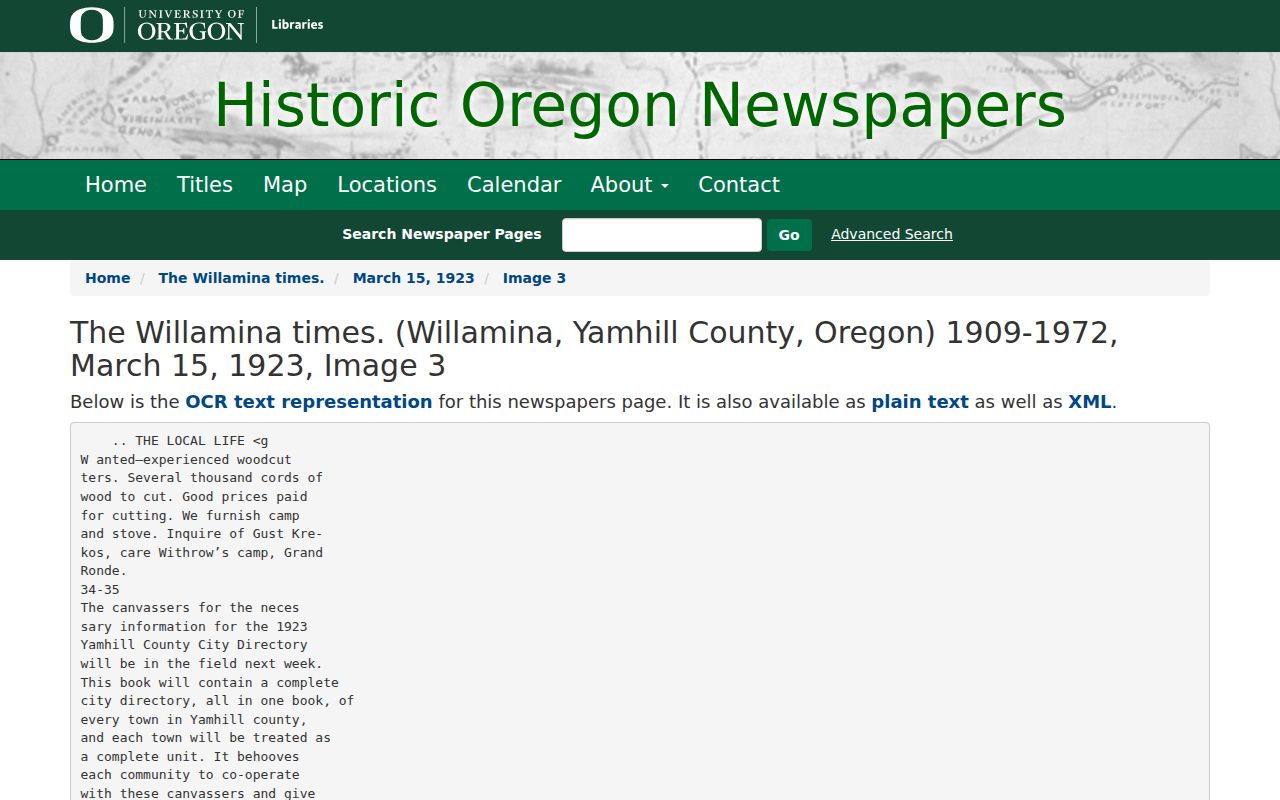
The notice supports the period's town-by-town canvass statement, but it does not establish an unbroken series of Newberg household directories.
For the collections themselves and the exact shelf gaps, consult the Newberg Directory Book. In a house trail, match a directory date to a deed before and after it, then check the nearest map and census. That keeps a printed listing in the correct time window.
Newberg Historic Address Maps
Newberg has five identified Sanborn editions on file at Newberg Public Library: 1892, 1902, 1905, 1912, and 1929. They add built-environment evidence when an older directory address is hard to recognize. Use the street layout, footprint, building use, corner streets, and nearby structures to test whether a number fits the period. A Sanborn sheet does not supply a resident name, so it should never stand in for a directory, census, or deed.
The City and George Fox Mapping Our History resources can add downtown address, business-timeline, structure, photo, and land-use context. They are especially useful around historic downtown and rail-era development, but a mapped business timeline is still distinct from a private household roster. Pair the map year with a directory year and a property record before deciding that two differently written addresses refer to the same place.
Newberg Address Variants Matter
The main continuity trap in Newberg is format, not a documented citywide renumbering. Current city addressing uses directional prefixes such as N and E. A 2018 Page Landing address-assignment notice says an East directional appears on street signs to match city addressing even though the older plat depiction lacked it. Historic sidewalk research also shows variation in numbered-street notation and suffix punctuation.
Preserve the original directory or map form first. Then search with and without the directional prefix and with abbreviated or full street-type words. Compare a nearby corner, block, parcel, and legal description before connecting a historic number to a later formatted address. The research found no official source for a citywide Newberg renumbering or a formal conversion table, so do not invent one to bridge a mismatch.
Note: City limits and annexations can change the right municipal office for permits, but Yamhill County remains the recorder for countywide property transactions.
Newberg Previous Residents in Permits
City permits can date work at an address, but they do not identify every household. Newberg directs users to search permits by address in the Oregon Records Management Solution, known as ORMS. Reviewed results display Title, Created Date, Record Number, Extension, and View Detail, with address-rich titles. The City is still adding records, and some indexes are temporarily unavailable. A missing ORMS hit is not proof that a historic file never existed.
Residential plans are retained for two years and commercial plans for five years. Community Development also offers an active-projects map, OpenGov search, staff contacts, and a counter route. For an older plan, code-compliance file, or unindexed city item, use the City Recorder's public-records request form. Give the exact address variants, date range, and keywords, because those details help staff identify the record. A listed applicant, contractor, or owner is a record-specific connection, not evidence of every resident.
Newberg Previous Residents, Census, Estates
When the deed and directory chain ends, archive sources can explain a transition without pretending to reveal restricted information. Oregon State Archives lists Yamhill estates from 1843 through 1942 and guardianships from 1850 through 1951 in the Oregon Historical Records Index. Its Yamhill guide also identifies early assessment rolls from 1852 through 1859 and census rolls from 1846 through 1856 with resident names. These are local historical leads that may point toward a family, estate, or county repository. For a later disappearance, the Museum's listed obituary files and the Newberg Graphic can help distinguish an estate event from a simple move.
The Oregon State Archives Yamhill guide is shown below.
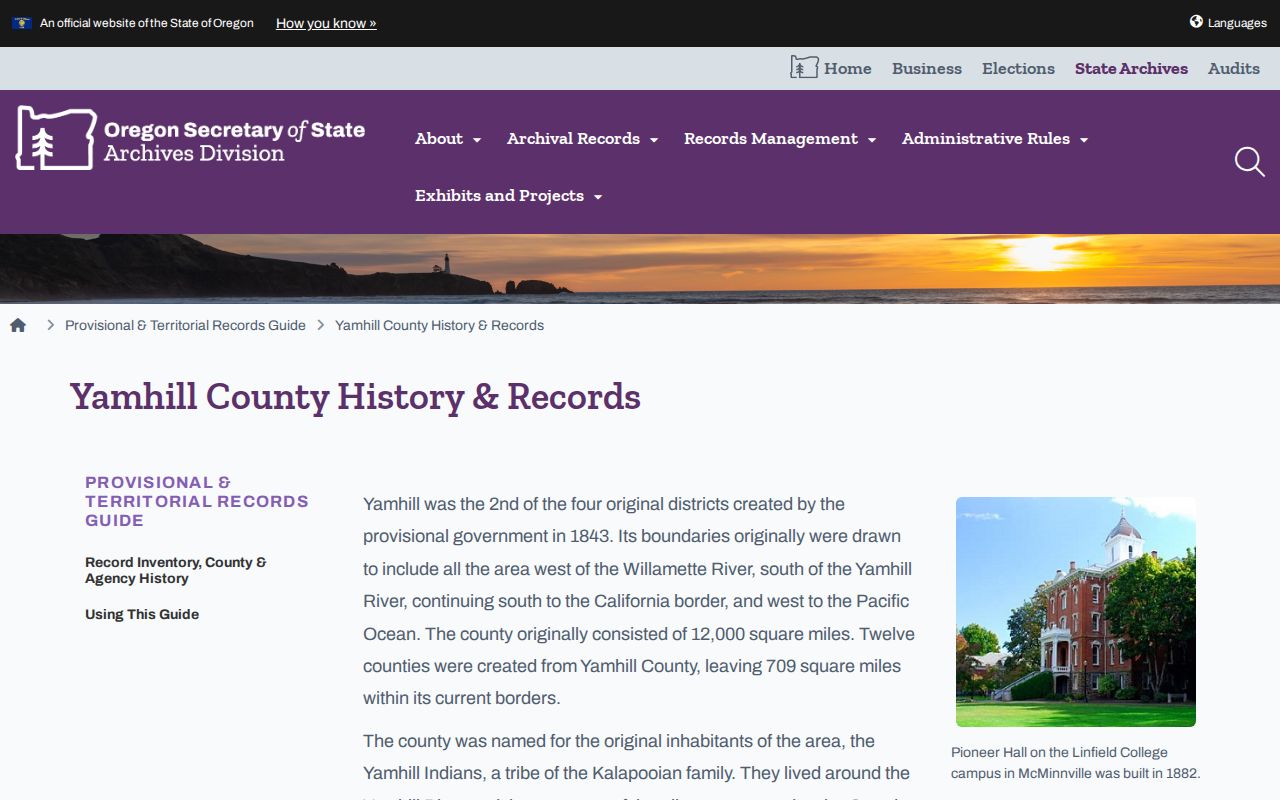
The guide is useful for choosing a record series, while the actual archive or custodian determines access and copy rules.
Yamhill naturalization records offer another historical bridge. The archive guide identifies certificate cards from 1853 through 1959, declarations from 1853 through 1956, an index from 1853 through 1951, and petitions from 1903 through 1959. Depending on era, a petition may provide residence, occupation, birth or arrival details, and witnesses. Treat it as a historical record route, not as a modern address search.
The Oregon Archives naturalization guide is represented below.
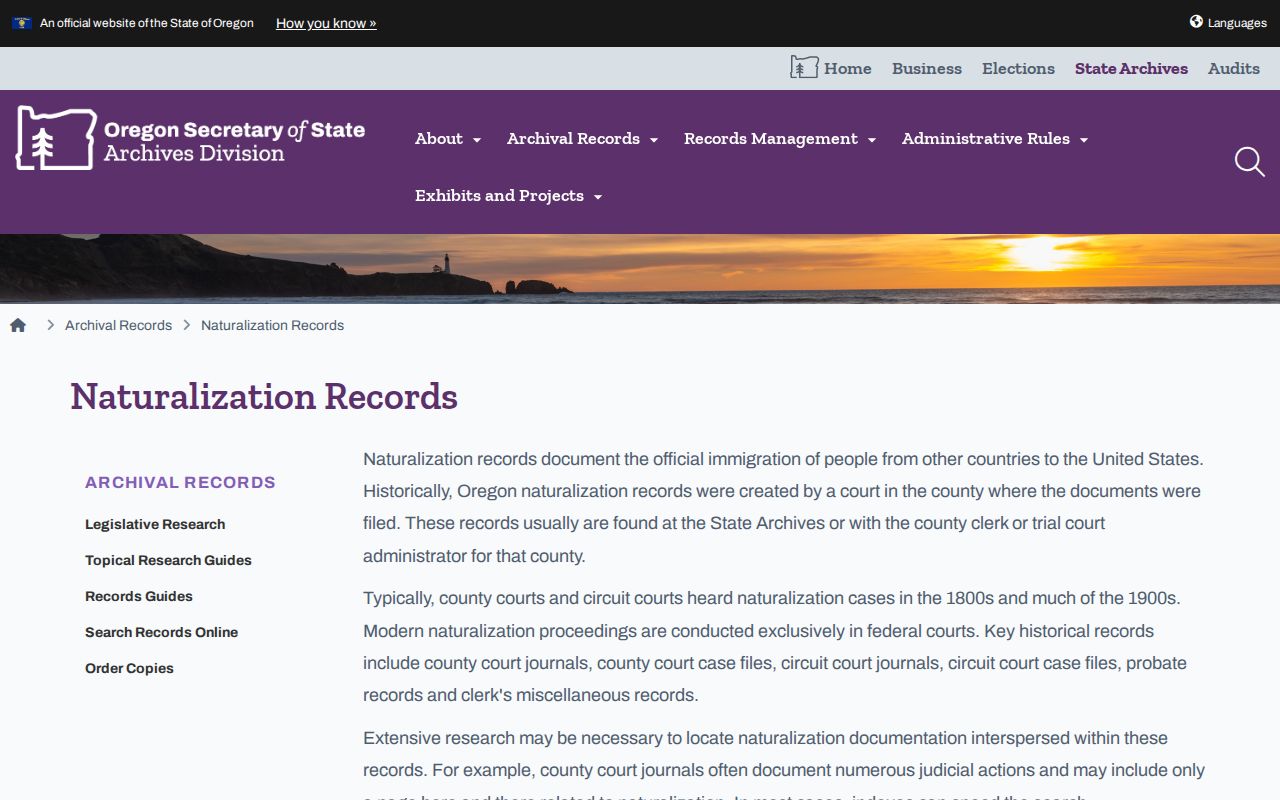
Archive index coverage can lead to a file, but the stated custodian and access conditions still control the record.
Newberg Previous Resident Research Limits
Past-resident work should stay focused on house history, family history, estate matters, and careful verification. Property records name assessed owners or recorded parties, not every household member or utility customer. Directory dates have gaps, tax mailing addresses can differ from the property, and court, vital, adoption, juvenile, protected-voter, and confidential-address records have separate restrictions. Oregon's Address Confidentiality Program provides substitute addresses for eligible survivors, so a protected address must not be pursued through alternate sources.
Lawful use. Use Newberg address history for personal, family, estate, and property research. Do not use records to stalk, harass, or track a living person, and respect confidential or protected-address records.
For a problem with an official record, take the correction question to the custodian that holds it: the Assessor for assessment data, the County Clerk for recorded instruments, or the City Recorder for municipal material. That preserves the line between a research lead and the official source.